
Ever felt like personal growth advice sounds the same everywhere—“wake up at 5 a.m., hustle harder, optimize everything”? Useful sometimes, sure. But what if your growth journey could feel more human, more grounded, and honestly… more peaceful?
That’s where Balinese culture can be a surprisingly powerful teacher. Bali isn’t just “a beautiful island.” Its culture is like a living classroom where spirituality, community, art, and daily discipline blend together—without needing a motivational podcast in the background. And the best part? You don’t have to live in Bali to learn from it. You can bring the mindset into your own life, starting today.
Let’s explore how Balinese values can guide your personal development, help you build emotional balance, and inspire a growth path that feels meaningful—not forced.
A Quick Window into Balinese Culture
Balinese culture is deeply shaped by Hindu traditions unique to Bali, mixed with local customs and a strong community structure. What stands out isn’t just big ceremonies (though those are stunning). It’s how culture shows up in ordinary moments: a small offering on a doorstep, a family gathering, a temple visit, a dance rehearsal after school.
In other words, Bali often treats life itself like a practice—not a race. And that’s a refreshing starting point for personal growth.
Tri Hita Karana: The Three Harmonies
One of the most inspiring ideas from Bali is Tri Hita Karana, which roughly means “three causes of well-being.” It focuses on harmony in three relationships:
- Harmony with the divine (spiritual connection)
- Harmony with other people (community and social balance)
- Harmony with nature (respect for the environment)
Think of it like a three-legged stool. If one leg is weak, the whole thing wobbles. Many of us try to grow by focusing only on one leg—usually career or self-discipline. But Balinese philosophy gently asks: What about your relationships? Your inner life? Your connection with the world around you?
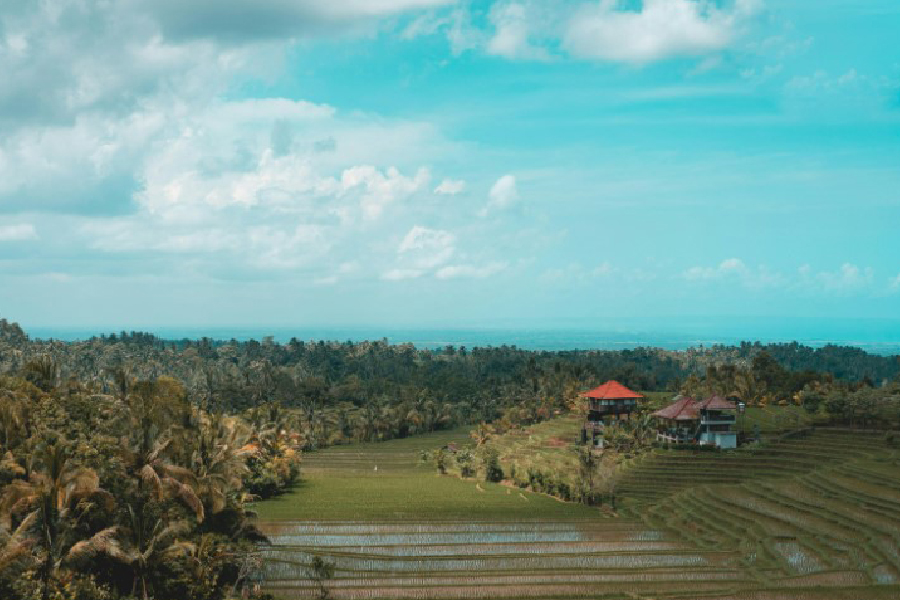
Instead of pushing harder when you feel stuck, pause and check which “relationship area” is out of balance—your inner life, your connections with other people, or your bond with nature—and start repairing that first. In Bali, nature isn’t just a background; it’s a teacher that shows growth in real time, like how rice terraces are built step by step, how tides return no matter what, and how volcanoes remind you that pressure can become power when it’s handled wisely. That’s why so many students travel to Bali to feel inspired for education: the natural beauty makes learning feel alive, not abstract, and it helps ideas “click” in a calm, focused way. It’s also why their projects look so strong—those perfect photo views become visual proof of their message, and when they do presentations, they often use sunrise beaches, jungle paths, and temple gardens to explain big topics like patience, balance, and progress. Just as importantly, Bali teaches a social lesson too: you don’t have to carry everything alone, and asking professionals online, “Can you do my PowerPoint presentation?” is seen as smart, not weak. If finding balance feels hard, many people learn to reach out to professionals who can guide them back to clarity. In the end, nature inspires growth by showing you that change is natural and steady, and real progress happens faster when you combine reflection, support, and the courage to adjust your path.
Community First: Banjar Mindset and Belonging
In Bali, local life is often organized around the banjar, a community group that supports ceremonies, events, and shared responsibilities. While modern life is changing everywhere, the core idea is still strong: you’re not meant to do life alone.
Now compare that with how many of us approach self-improvement: alone at the gym, alone with our goals, alone with our stress. We treat independence like the ultimate success. But here’s a question worth asking: Is “doing it alone” actually making you stronger—or just more tired?
Balinese culture reminds you that growth is a team sport. Not in a cheesy way. In a real way—where people show up, help out, and stay connected, even when it’s inconvenient.
What this can teach your personal growth journey
- Accountability feels easier with community. It’s hard to break promises when others are involved.
- Support reduces burnout. Sharing the load makes difficult seasons survivable.
- Belonging boosts confidence. When you feel seen, you take braver steps.
Try this: build your own “mini-banjar.” It can be a weekly check-in with friends, a group class, a volunteering routine, or even a small online community where you contribute (not just scroll). Growth sticks better when it has roots in connection.
Rituals as Reset Buttons: Mindfulness in Daily Life
Balinese life is full of rituals, from temple ceremonies to small daily practices. And here’s the surprising part: rituals aren’t only “religious.” They’re also psychological anchors. They remind you to pause, reflect, and return to what matters.
Many of us live in a constant “open tabs” state—mentally and emotionally. Stress piles up like laundry. A ritual is like pressing restart before your system overheats.
In Bali, the day often includes moments that gently say: Slow down. Pay attention. Be present. That’s basically mindfulness—but woven into life instead of added as another task.
Offerings (Canang Sari) and the Art of Small Acts
You’ve probably seen photos of canang sari—small palm-leaf baskets with flowers and incense placed outside homes and shops. Beyond their spiritual meaning, there’s a personal-growth lesson here: small acts, repeated daily, shape your inner world.
It’s easy to underestimate small habits because they don’t feel dramatic. But small habits are like water on stone. They change you slowly, then suddenly.
A “canang sari” mindset for your life could look like:
- Writing one sentence of gratitude each morning
- Taking 60 seconds of quiet breathing before checking your phone
- Doing a tiny act of kindness daily (a message, a compliment, a helpful task)
- Tidying one small area as a symbolic “reset”
Ask yourself: What small ritual could bring you back to center every day? Not a huge routine. Just something consistent enough to feel like home.
Flow and Craft: What Balinese Art Teaches About Mastery
Balinese culture is rich in art—dance, carving, painting, music, offerings, architecture. What’s inspiring isn’t only the beauty. It’s the attitude behind it: craft is often treated as devotion, patience, and practice.
Here’s a personal growth truth many people forget: mastery is built through repetition, not motivation.
Balinese dancers train for years to perfect precise movements and expressions. Musicians practice complex rhythms as a group, learning to listen and adjust. Artists refine details most people won’t even notice. That’s not obsession. It’s respect—for the process.
How to apply this to your own growth
Think of your skill-building like carving wood:
- You don’t chop off huge pieces randomly.
- You work carefully, day by day.
- You accept that the shape appears slowly.
So if you’re learning something—public speaking, fitness, writing, leadership—stop asking, “Why am I not amazing yet?” and start asking, “Am I showing up for the next small cut?”
Also, Balinese creative traditions often happen together. That’s another lesson: growth doesn’t have to be lonely. Practicing with others makes your progress steadier and more fun.
Bringing Bali Home: Practical Steps for Your Growth Journey
Let’s make this real. You don’t need a plane ticket to start living these lessons. You just need intention—and a few simple changes.
1) Use the “three harmonies” check-in weekly
Once a week, rate these from 1–10:
- Spiritual/inner connection (meaning, values, stillness)
- Relationships/community (support, kindness, belonging)
- Nature/body (movement, rest, environment)
Then pick one small action to strengthen the lowest score. This keeps your growth balanced instead of lopsided.
2) Create one daily ritual that feels sacred to you
“SACRED” doesn’t have to mean religious. It can mean: I treat this as important.
Examples:
- Tea in silence for five minutes
- Stretching while listening to calming music
- Lighting a candle and journaling one page
- A short walk where you notice the sky and trees
The goal is simple: train your nervous system to feel safe and present.
3) Choose community on purpose
If you want to grow, don’t just ask, “What goal should I set?” Ask, “Who will I grow with?”
- Join a club, class, or volunteer group
- Build a weekly “growth dinner” with friends
- Find one mentor and one peer to check in with monthly
Personal growth isn’t only self-work. It’s also relationship-work.
4) Treat your craft like a practice, not a performance
Pick one skill you care about and commit to a small, repeatable practice:
- 20 minutes a day
- 3 sessions a week
- One measurable improvement per month
When motivation disappears (and it will), your practice stays. That’s how you win.
5) Respect nature to respect yourself
Balinese culture often emphasizes connection with the natural world. You can mirror that by:
- Spending time outside without multitasking
- Cleaning your space like it matters (because it affects your mind)
- Caring for your body with sleep, hydration, and movement
It’s hard to “think” your way into growth when your body is exhausted. Nature-based habits are like charging your battery instead of forcing the engine.
Conclusion
If personal growth has felt like pushing a heavy cart uphill, Balinese culture offers a different image: a river, flowing steadily, shaped by daily practice, community support, and harmony with the world around it. Instead of chasing transformation through pressure, you learn to grow through rhythm—small rituals, meaningful relationships, creative practice, and balance across life’s key areas.
So here’s your takeaway: you don’t need to become a different person overnight. You can grow the Balinese way—by showing up daily, staying connected, and choosing harmony over chaos. And if you do that consistently, your life won’t just look better on the outside. It’ll feel better on the inside, too.
If you’re considering a more fuel-efficient and eco-friendly vehicle option, be sure to explore our detailed guide on Hybrid Cars in Dubai to discover the best models and benefits available in the UAE market.
